
Consolidation Rumors Are Never Just Rumors
There was some interesting UniFirst chatter today.
I had a conversation with a UniFirst insider that included this statement, verbatim:
“I don’t see the Cintas acquisition happening.
At least that’s what they’re feeding us internally at UniFirst.
Only time will tell though…”
That quote matters less for what it claims and more for what it reveals.
Internal messaging like this is almost never about certainty. It’s about posture.
When leadership feels the need to proactively say “this isn’t happening,” it’s usually not because nothing is happening. It’s because something might be happening — and they’re trying to control narrative, confidence, and morale before uncertainty spreads.
You don’t manage expectations unless there’s pressure.
You don’t calm the room unless the room is already uneasy.
Acquisition chatter doesn’t surface inside organizations that are perfectly stable, perfectly aligned, and perfectly unconcerned. It shows up when leverage shifts, growth slows, capital gets more expensive, or strategic options narrow.
So whether this specific deal happens or not almost misses the point.
The existence of the message itself is the signal.
Pressure Is the Tell, Not the Outcome
What Customers Actually Experience
The Dangerous Assumption Most Clients Make
Most customers hear rumors like this and think:
“We’ll deal with it if something actually happens.”
That thinking is expensive.
Because billing behavior does not wait for press releases, regulatory approval, or official confirmation. It changes quietly and early — upstream — in how rates are applied, how fees are interpreted, and how contract language is enforced day to day.
Nothing dramatic shows up all at once. There’s no single red flag. Just small decisions made inside systems: which line items get adjusted, which discrepancies get ignored, which “temporary” charges are allowed to stick.
By the time a deal is announced — or officially dies — the math has often already shifted.
And even if the acquisition never happens, the behavior rarely rolls back. Processes don’t revert. Pricing discipline doesn’t loosen. Complexity doesn’t disappear.
Customers waiting for certainty usually discover it too late — when the invoices still look familiar, but the totals no longer do.
The Calm Before the Drift
Consolidation rumors are often the calm before billing behavior changes.
No alerts.
No warnings.
No announcement that anything is different.
Just invoices that still look familiar — same format, same cadence, same vendor — but add up differently over time.
This is how cost shifts actually happen. Not through a single increase you can point to, but through accumulated interpretation: how rates are applied, how fees are categorized, and how contract language is enforced when no one is looking closely.
If your uniform or linen program is:
Approved automatically
Reviewed casually
Checked only at renewal
Then you are not positioned defensively for this environment.
You are exposed to it.
Because consolidation doesn’t create new behaviors — it accelerates existing ones. And any account not actively monitored becomes the easiest place for that acceleration to land.
By the time leadership notices a problem, the system has already been doing exactly what it was allowed to do for months — sometimes years.
Final Thoughts
Whether Cintas ever acquires UniFirst is a headline question.
The operational question is simpler — and far more important:
Are your invoices being enforced against your contract today, or are you trusting that nothing has changed?
Because consolidation pressure doesn’t wait for outcomes. It changes behavior in advance. Systems tighten. Interpretation shifts. Flexibility disappears quietly.
And when that pressure exists, something always does — even if no deal ever makes the news.
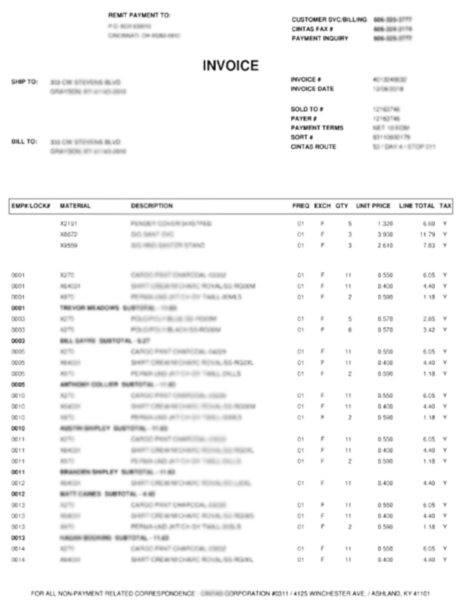
Don’t Wait for the Headline
Waiting for consolidation “confirmation” is expensive.
The fix is simple: enforce the contract you already have before billing drift becomes permanent.
At The Laundry Guy, we verify the math — line by line — to answer one question:
What should this program actually be costing you?
All we need is one invoice:
-
No vendor change
-
No disruption
-
No obligation if everything checks out
If the numbers are right, you get confirmation.
If not, you get credits and leverage.
Invoices change. Contracts don’t.