
Approved Isn’t Accurate: Why CFOs Are Overpaying for Uniforms and Linens Without Knowing It
Most CFOs don’t think uniform, linen, and facility services spend is a problem.
It’s relatively small.
It’s operational.
It’s been “stable” for years.
And that’s exactly why it leaks.
Not loudly. Not dramatically. Quietly—through unchecked invoices that are approved every week and almost never verified against the contract that governs them.
This is not a vendor integrity issue.
It’s a control issue.
The Illusion of Control
From a finance perspective, uniform and linen programs appear deceptively simple:
-
Fixed weekly invoices
-
Predictable service cadence
-
Long-term contracts already negotiated
-
No obvious spikes or anomalies
Invoices flow in. AP processes them. Someone approves them. The spend feels controlled.
But approval is not validation.
In most organizations, no one is reconciling each line item on those invoices against:
-
Contracted rates
-
Authorized garment classifications
-
Approved quantities
-
Location-specific terms
The assumption is that “someone must be watching.”
In practice, no one is.
How the Money Actually Leaks
When we audit uniform and linen programs, we rarely find catastrophic errors. What we find instead is far more dangerous:
-
Contract rates quietly exceeded
-
Items reclassified into higher-margin categories
-
“Temporary” fees that never leave
-
Garments upgraded without approval
-
Locations billed inconsistently under the same agreement
Each issue, on its own, looks immaterial.
Together, over months and years, they compound into five- and six-figure losses—without triggering alarms, internal audits, or vendor disputes.
Every invoice was approved.
Very few were correct.
Why This Escapes CFO Oversight
This spend lives in an uncomfortable gap:
-
Too operational to command executive attention
-
Too small per invoice to trigger materiality thresholds
-
Too routine to invite scrutiny
By the time contract renewal discussions begin, the damage is already baked into the baseline. The organization ends up negotiating from a distorted cost structure created by years of unchecked billing drift.
At that point, the conversation is about “rates,” not recovery.
That’s too late.
Enforcement Beats Renegotiation
-
Most vendors don’t need bad contracts to win.
They just need time.
Time for exceptions to become permanent.
Time for invoices to blend into routine.
Time for assumptions to replace verification.At The Laundry Guy, we don’t focus on renegotiation first. We focus on enforcement.
We audit invoices line by line against the existing contract—across locations, over time, and without disrupting operations.
In many cases:
-
The contract is fine
-
The service is fine
-
The billing is not
We’ve recovered tens of thousands of dollars for CFOs simply by forcing the math to reconcile—without vendor changes, service reductions, or operational disruption.
-
The Real Question CFOs Should Ask
The right question isn’t: “Do we think this spend is okay?”
It’s: “Has anyone actually proven it?”
Because if invoices are being approved instead of verified, the risk is already there—whether you see it or not.
What Certainty Looks Like
A proper invoice audit delivers one of two outcomes:
Everything checks out
You gain certainty and close a blind spot in your cost controls.
It doesn’t
You recover money that should never have left the business.
Both outcomes are wins.
And it doesn’t require a full program overhaul.
All it takes is one invoice.
Final Thoughts
Uniform and linen costs don’t erode margins dramatically.
They erode them quietly.
And quiet losses are the hardest to detect—until someone actually looks.
If you want to know whether money is leaking or finally put the issue to rest, start with enforcement.
One invoice is enough.
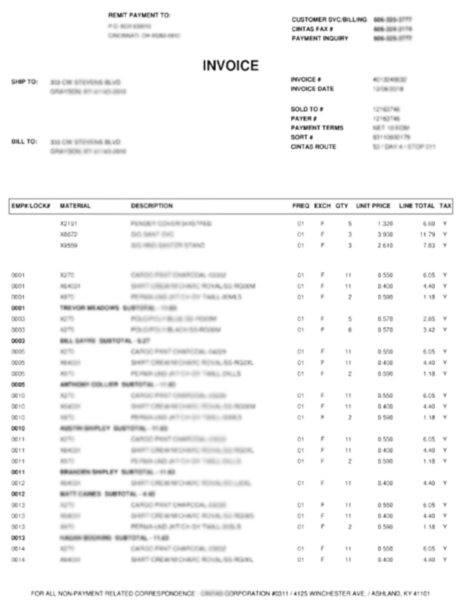
Approved Invoices Aren’t Proof. One Check Is.
If your uniform, linen, or mat invoices are being approved without a line-by-line contract check, you are trusting math you didn’t verify.
At The Laundry Guy, we audit invoices against the contract you already have—no vendor changes, no operational disruption, no guesswork.
If everything is correct, you get certainty.
If it isn’t, you get your money back.
All we need is one invoice to tell you which one it is.