
The Difference Between “Approved” and “Correct” Invoices
Most companies believe an approved invoice is a safe invoice.
It isn’t.
Approval only means someone clicked “yes.”
Correct means the math, pricing, quantities, and terms actually align with the contract you signed.
Those two things are rarely the same.
And that gap is where uniform, linen, and mat costs quietly spiral out of control.
How Invoices Actually Get Approved
Let’s be honest about how this works inside most organizations.
Invoices are approved because:
The service showed up
The amount looks similar to last week
Nothing feels “wrong” operationally
The invoice doesn’t trigger a dollar threshold
AP needs to clear the queue
Approval is a workflow decision, not a validation process.
No one is pulling the contract.
No one is checking historical rates.
No one is validating quantities by location.
No one is reconciling “temporary” charges.
The invoice gets approved because it looks normal.
That’s the problem.
What “Correct” Actually Means (And Why It’s Rare)
A correct invoice must pass all of the following tests:
Every line item matches the contracted rate
Quantities reflect actual inventory in use
No unauthorized add-ons appear
Temporary charges were removed on time
Price escalators were applied exactly as written
Location billing aligns with the master agreement
That requires line-by-line contract enforcement, not surface-level review.
Most companies never do this—not because they’re careless, but because they assume approval equals correctness.
Vendors rely on that assumption.
Why Errors Don’t Trigger Alarm Bells
Uniform and linen overbilling doesn’t show up like fraud.
It shows up like this:
$1.25 higher per shirt
A few extra garments that “might be needed”
A service fee that never goes away
A location billed differently than the others
A rate adjustment that blends into normal variance
Nothing explodes.
Service continues.
Invoices keep getting approved.
By the time someone asks, “How did this get so high?” the answer is simple:
It wasn’t wrong enough to stop payment.
It was just wrong enough to compound.
Approval Protects Vendors, Verification Protects You
Vendor billing systems are designed for scale, not precision.
They assume:
Clients won’t check every line
Discrepancies won’t be challenged retroactivelyOperational satisfaction equals billing acceptance
That doesn’t make vendors evil.
It makes passive oversight expensive.
When invoices are only approved—not verified—vendors win by default.
The Real Cost of Confusing the Two
The biggest misconception is thinking this is a “small” problem.
Across multi-location organizations, the difference between approved and correct invoices often represents:
Tens of thousands in annual overbilling
Years of compounded errors
Missed credits that can’t be recovered later
Higher renegotiation baselines at renewal
Waiting until contract expiration doesn’t fix this.
By then, the damage is already baked in.
What Changes When Invoices Are Actually Checked
When invoices are audited against contract terms:
Errors surface quickly
Credits get issued
Programs stabilizeVariance disappears
Leadership regains cost control
Sometimes we find issues.
Sometimes everything checks out.
Both outcomes matter.
Because certainty beats assumption every time.
Final Thoughts
An approved invoice means someone processed it.
A correct invoice means you paid what you were supposed to—and not a dollar more.
If your uniform or linen invoices are being approved without a contract-level review, you’re not controlling spend.
You’re trusting it.
And trust is not a control mechanism.
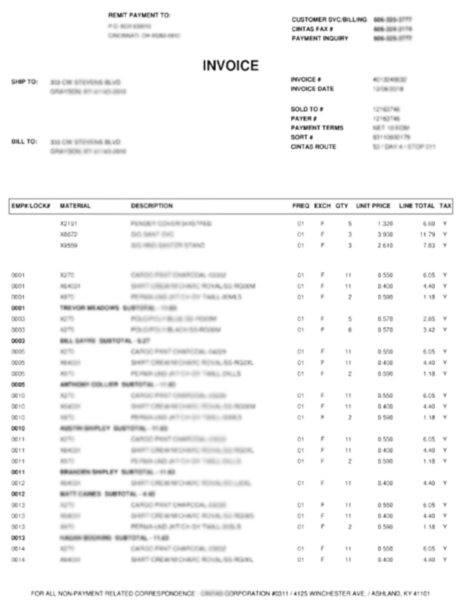
Verify Before You Renew
If your uniform, linen, or mat invoices are being approved without a line-by-line contract check, you don’t know what you’re paying for—you’re just paying it.
At The Laundry Guy, we audit invoices against the actual contract terms you already have.
No vendor changes.
No operational disruption.
Just verified math.
If everything is correct, you get confirmation and peace of mind.
If it’s not, you get your money back.
Before you wait for a renewal or assume costs are “normal,” find out which invoices are approved—and which ones are actually correct.
Upload a recent invoice or request a review.