
Why Laundry Providers Raise Prices Without You Noticing
Most companies don’t wake up one day to a massive uniform or linen price increase.
Instead, they look back a few years later and ask a much more dangerous question:
“How did this get so expensive?”
The answer is almost never a single rate hike or a bad contract.
It’s quiet. Incremental. And hidden in plain sight—inside invoices that were approved, but never truly checked.
At The Laundry Guy, this pattern shows up across nearly every audit we run, whether the provider is Cintas, UniFirst, or Vestis.
The Biggest Misconception: “Our Contract Has Us Covered”
Most leadership teams believe their laundry spend is controlled because:
-
Pricing was negotiated
-
A contract is in place
-
Invoices are approved every week
That belief is exactly what allows prices to rise without resistance.
Contracts don’t enforce themselves.
Invoices don’t validate accuracy.
And approval is not the same thing as verification.
Laundry providers don’t need bad contracts to win.
They just need time—and passive oversight.
How Prices Actually Increase (Without a Headline)
Laundry providers rarely send a clean email saying, “We’re increasing your pricing.”
Instead, increases happen through billing mechanics that look ordinary week to week.
Here’s what we consistently see.
Rate Drift That Feels Like “Normal Variance)
A shirt goes up $0.85.
A towel increases $1.10.
A mat jumps a few percentage points.
No single change triggers alarm bells.
But across:
-
Hundreds of wearers
-
Dozens of locations
-
52 billing cycles per year
That drift compounds into tens of thousands annually.
Laundry Guy example:
A multi-location auto group had strong negotiated pricing. On paper, it looked competitive.
But over time, small per-item increases crept in across multiple locations.
Total recovered: ~$40,000, without changing vendors or service levels.
“Temporary” Charges That Quietly Becomes Permanent
-
Fuel surcharges.
Environmental fees.
Emergency service add-ons.These are often introduced legitimately—but rarely removed automatically.
If no one tracks when they should come off, they stay forever.
Laundry Guy example:
We audited a national account where a “temporary” fee added during a service issue was still being billed years later.
The client assumed it was standard.It wasn’t.
Silent Inventory Creep
Extra garments added “just in case.”
Backup sets never removed.
Employees long gone but still being billed.
Laundry providers don’t always know when someone leaves unless they’re told—and many programs lack a clean removal process.
So inventory grows.
Invoices follow.
Laundry Guy example:
In one audit, we found locations paying for uniforms assigned to employees who had left years earlier, including individuals no longer with the company at all.
The invoice looked normal.
The headcount hadn’t changed.
The cost still went up.
Location-by-Location Inconsistencies
Multi-location companies assume uniform pricing is consistent.
It rarely is.
Different rates, quantities, and fees by location are extremely common—especially when programs grow over time.
Laundry Guy example:
A 30-location client discovered identical garments billed at different rates across sites, despite a single master agreement.
Those inconsistencies alone drove nearly $60,000 in recoverable overbilling
Escalators Applied Incorrectly (or Automatically)
Most contracts allow price increases—but under strict rules:
-
Timing
-
Percentages
-
Excluded items
Billing systems often apply escalators automatically, and once applied, they’re rarely reversed unless challenged.
Laundry Guy example:
We routinely see escalators applied:
-
Too early
-
At the wrong percentage
-
To items exempt from escalation
Once baked in, those increases become the new baseline at renewal.
Why No One Notices
Because nothing breaks.
Service continues.
Deliveries show up.
Invoices “look right.”
AP approves them to clear the queue.
Operations assumes Finance is watching.
Finance assumes the vendor is billing correctly.
Everyone is reasonable.
No one is verifying.
Approval is a workflow decision—not a control mechanism.
Why Waiting Until Renewals Is Too Late
Many companies say: “We’ll fix this when the contract expires.”
By then:
-
Overbilling has compounded for years
-
Errors are normalized
-
Credits are unrecoverable
-
Negotiations start from an inflated baseline
You’re negotiating against distorted data.
That’s the most expensive position to be in.
What Actually Stops the Bleeding
The only thing that works is invoice-level contract enforcement
That means:
Line-by-line rate verification
Quantity validation by location
Removal of unauthorized charges
Escalator enforcement
Credit recovery
Sometimes everything checks out.
Sometimes it doesn’t.
Both outcomes are valuable—because certainty beats assumption every time.
Final Thoughts
Laundry providers don’t raise prices loudly.
They raise them quietly—inside invoices that no one is validating.
An approved invoice only means it was processed.
A correct invoice means you paid exactly what you agreed to.
If your laundry invoices aren’t being checked against the contract, pricing is drifting right now.
Not because anyone failed.
But because unchecked systems always drift.
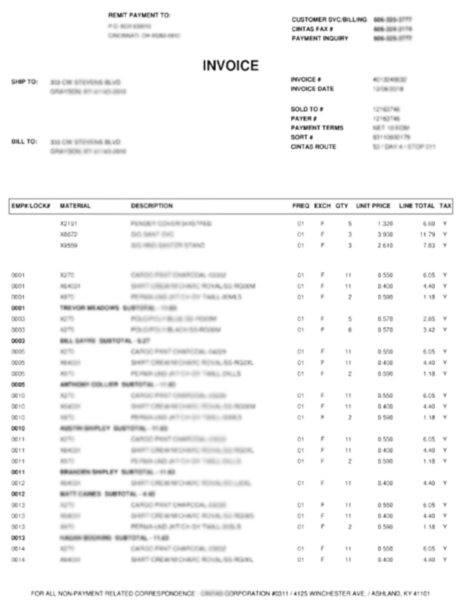
Send One Invoice, Find Out What You’re Really Paying
If your laundry invoices are being approved but never checked against the contract, pricing is drifting right now.
At The Laundry Guy, we audit uniform and linen invoices line by line to answer one simple question:
What would this program cost if the math were actually correct?
No vendor switch.
No operational disruption.
No obligation if everything checks out.
One recent invoice is enough to know.
👉 Submit an invoice or request a review