
The Invoice You Don’t Check Is the One Costing You the Most
Most companies assume the invoices that matter are the big ones.
They’re wrong.
The most expensive invoice is usually the one that looks routine, gets approved automatically, and never raises a question. It’s the invoice no one checks—because it has always been there, the service seems fine, and the dollar amount doesn’t feel urgent.
That’s exactly why it costs so much over time.
Why “Normal” Invoices Are the Most Dangerous
Uniform and linen invoices are designed to blend in.
They:
-
Arrive weekly or bi-weekly
-
Look similar month after month
-
Contain familiar line items
-
Increase slowly enough to avoid scrutiny
Nothing feels broken. Service continues. Payments go out.
But beneath that normalcy, costs drift—quietly and consistently.
Small Errors Compound Faster Than Big Ones
Overbilling in uniform and linen programs rarely shows up as a single, obvious mistake.
It shows up as:
-
A rate that’s slightly higher than contracted
-
A fee that was added and never removed
-
An employee who left but is still being billed
-
Inventory counts that no longer reflect reality
Each issue feels minor. Together, they create a material financial leak.
This is how companies lose $50,000–$250,000 per year without realizing it.
Accounts Payable Isn’t Built to Catch This
AP teams do exactly what they are supposed to do:
-
Confirm the invoice matches the vendor
-
Check the math
-
Process payment on time
They are not responsible for validating:
-
Contract compliance
-
Historical pricing drift
-
Eligibility of recurring charges
-
Whether service levels match billing
When invoices are treated as routine, they stop being questioned—and that’s when the leakage accelerates.
Why This Rarely Triggers Internal Alarms
-
Uniform and linen costs are operationally fragmented:
-
Spread across locations
-
Categorized as facilities or operating expenses
-
Incremental enough to avoid executive attention
There’s no single moment where the problem becomes obvious.
By the time someone asks, “Why is this so high?” the answer is usually:
“It’s been like this for years.” -
The Illusion of Control
Many organizations believe they are protected because:
-
They negotiated hard upfront
-
They have a signed contract
-
They’ve used the same vendor for years
-
Service levels seem acceptable
None of that guarantees billing accuracy.
Without active oversight, contracts become irrelevant and invoices become self-validating.
Final Thoughts
The invoices that get the least attention are the ones that quietly do the most damage.
Not because they are fraudulent.
Not because vendors are openly malicious.
But because unchecked systems reward drift.
If invoices are not reviewed against contract terms, inventory realities, and historical patterns, costs are not controlled—they are inherited.
Oversight is not about mistrust.
It is about visibility.
And visibility is the difference between a managed expense and a silent loss.
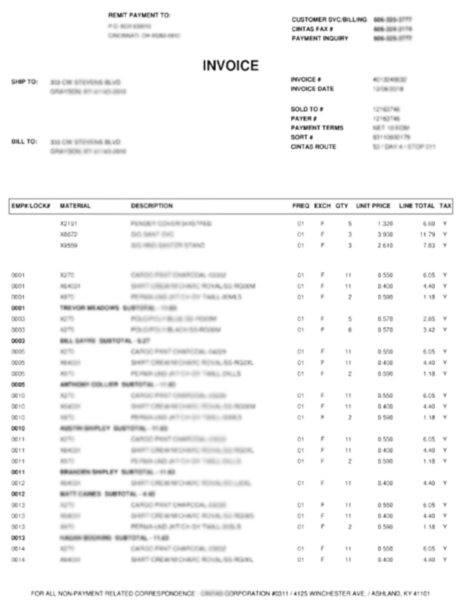
Find Out What Your Invoices Are Really Costing You
You don’t need to change vendors.
You don’t need a disruptive overhaul.
You need clarity.
The Laundry Guy reviews uniform and linen invoices for contract compliance, billing accuracy, and hidden cost leakage—often starting with just one invoice.
👉 Send us a recent invoice and we’ll tell you what’s really happening.
Because the invoice you don’t check is often the one costing you the most.